Andrey Duras
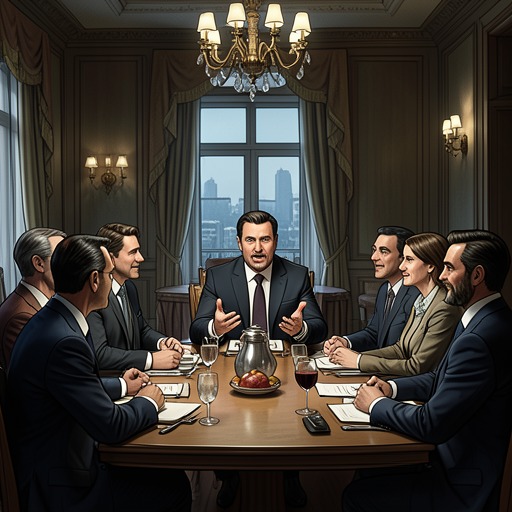
A Gentleman in MoscowAndrey Duras is the maître d’ of the Boyarsky Restaurant, where precision of service is both a professional discipline and a form of care. Tall, handsome, and graying at the temples, he is distinguished above all by his unusually long, finely kept hands. He uses them to make a crowded restaurant run smoothly, to protect its standards, and to express loyalties that outlast changes in status and circumstance. His role joins the practical and the ceremonial: he can orchestrate a table with seemingly effortless grace, yet also stand beside his friends in moments of welcome, trouble, and departure.
Identity and Place in the Boyarsky
Born in the south of France, Andrey is described as the person who secures the Boyarsky Restaurant’s reputation by ensuring that everything within it runs smoothly. Emile Zhukovsky may be a genius, but the restaurant’s daily excellence depends on Andrey’s command of its many small operations. He is its captain: not simply a figure who directs others, but the person whose hands and attention turn intention into a functioning service.
The narrative makes his hands the defining feature of his appearance and craft. They are pale and well manicured, and his fingers are about half an inch longer than those of most men of his height. The description imagines that he could span a twelfth on a piano or manipulate several puppets at once, then redirects those possibilities toward the work he actually performs. The comparison makes his everyday competence seem unexpectedly theatrical without suggesting that it is mere show. His hands are remarkable because they make many simultaneous acts appear coordinated and natural.
The Craft of Service
A demonstration of Andrey’s skill begins with a group of women arriving at a table. He seems to draw back all their chairs at once. When one asks for a light, he has a lighter ready and shields its flame with his other hand, although the Boyarsky is not troubled by drafts. When another asks for a wine recommendation, he indicates the 1900 Bordeaux with a slight extension of his index finger, a gesture the narration compares to the transmission of life in a painting of creation. He then bows and crosses the room toward the kitchen, moving between the public dining room and the operations that support it.
That movement brings his partnership with Emile into view. Emile emerges from the kitchen to rebuke the Count’s apparent success at identifying nettle, exclaiming, “Bravo, monsieur,” before returning to his kitchen. Andrey follows, slightly breathless, and bows in a gesture that conveys both apology and congratulations. He confirms that the Count’s guess was right and acknowledges that the Count’s palate remains unsurpassed. The exchange gives Andrey a place between chef and guest: he safeguards the restaurant’s standards while helping sustain the friendly contest that animates its dining room.
Service also depends on attention to what a customer does not say outright. At the Boyarsky, Andrey’s work represents the attentive, anticipatory side of hospitality: he moves among diners, reads requests, coordinates with the kitchen, and preserves the ease of the room. The story later makes explicit that a capable waiter must overhear the quiet exchanges around a table. That principle helps define the social intelligence required by Andrey’s position, even when he is not the waiter attending the particular dinner in question. In a restaurant where private conversation can matter as much as the meal, discreet attention is part of the service itself.
Loyalty and Changing Social Rules
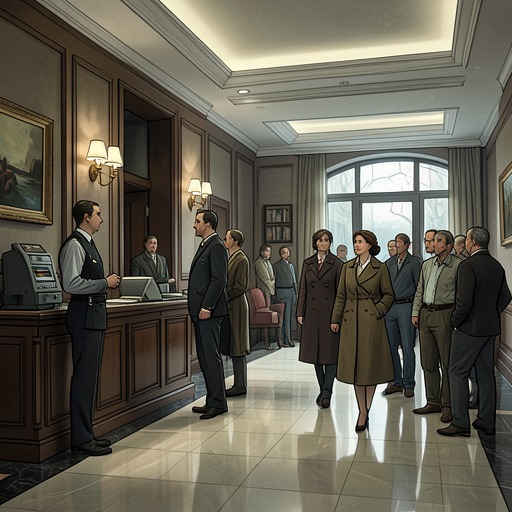
When Count Alexander Ilyich Rostov returns to the hotel after being sentenced to spend the rest of his life there, Andrey is among the three staff members who come to his room, alongside Vasily and Marina. The Count recognizes Andrey’s familiar throat-clearing in the hallway before turning to find the visitors. Their bewildered expressions reflect the belief that he would not return from the Kremlin. Once the Count explains his sentence, the staff respond with cheers, and he shakes each visitor’s hand in thanks for their fellowship. Andrey’s presence makes that welcome more than an individual reunion: it shows the bonds of the hotel staff surviving the political decision that confines the Count there.
Those bonds exist within a changed public order. The hotel manager tells the Count that staff have continued addressing him as “Your Excellency” and says he must insist that they stop using such honorifics. His explanation is hesitant, but the implication is clear: the old forms of address have become politically difficult. The Count answers that it is the business of the times to change and the business of gentlemen to change with them. The episode places Andrey’s courteous manner within a conflict between inherited deference and a new regime’s expectations. The evidence establishes the staff’s continued use of the title, though it does not single Andrey out as the person who addressed the Count in that way.
Andrey’s loyalty is not presented as a formal protest. It appears instead in the durability of professional and personal fellowship. Years later, he, Emile, and the Count act together in defense of the Boyarsky’s customers. When the Count approaches Bishop Leplevsky about a concern affecting the restaurant, he clarifies that he has come of his own accord, but also explains that the three colleagues are dedicated to ensuring customer satisfaction. Their shared purpose gives Andrey’s exacting standards a collective dimension: the restaurant’s service is something they protect together.
Colleague, Friend, and Member of the Hotel Community
The three colleagues are sometimes treated as a unit, the Triumvirate, whose daily meetings bring professional business and recollection into the same room. A conversation between Andrey and Emile turns toward the past and the question of whether things have changed. Before they can linger there, Bishop Leplevsky enters and asserts that future meetings should not begin until he has arrived. Emile responds with an audible grunt. The interruption exposes a tension between the colleagues’ established habits and the manager’s authority, while the Triumvirate’s shared history gives their meetings a character beyond routine administration.
Andrey’s fellowship also reaches into family stories. While speaking with Sofia, the Count recalls that he came to know her Aunt Marina through repeated visits to a balcony, where he split the seat of his trousers every other time. Sofia laughs, and the Count goes on to remember that her mother, when thirteen or fourteen, came there to conduct experiments. Andrey is not present in that exchange, but the anecdote places Marina within the hotel’s continuing network of relationships, the same community in which Andrey serves and befriends colleagues across generations.
When illness threatens Andrey’s ability to oversee an important state dinner, he has already contacted comrade Propp at the Kremlin. Andrey explains that he cannot supervise the event the following night and arranges for Headwaiter Rostov to assume his responsibilities. Propp is relieved. He knows Rostov’s practical reliability from experience, although he does not know that the headwaiter is a Former Person under house arrest at the Metropol. Andrey’s decision thus connects his own absence to the Count’s concealed political status: to Propp, the appointment is simply reassurance that the table will be handled properly.
Public Duties and Farewell
The arrangements for the state dinner are exacting. At a morning meeting in the Boyarsky, Propp reviews the opening time of nine o’clock, a long U-shaped table with twenty seats on each side and six at its head, the menu, a Ukrainian white wine, and the requirement that the candles be extinguished at exactly 10:59. Andrey has prepared for this transfer of responsibility by placing Rostov in charge. His competence is visible in the arrangements themselves and in Propp’s confidence that the Count will attend to every detail and respond to even the slightest sign of dissatisfaction.
Andrey later helps turn private affection into a small restaurant ritual. During a meal with Sofia and the Count, a little figure’s chime calls him into the study, pushing a Regency cart topped with a silver dome. He greets them, clears their soup bowls, and places them on the cart’s lower shelf. Before lifting the dome to reveal Emile’s next course, he produces a pad and asks them to sign confirmation that they are satisfied with the soup. The Count’s shocked expression prompts laughter from Andrey and Sofia; then Andrey presents Emile’s specialty, Goose à la Sofia, and explains its absurd preparation. The joke depends on the formal machinery of service—the cart, the dome, the satisfaction form—being used to heighten the surprise of a dish made for the occasion.
When Sofia leaves, Andrey joins the hotel’s farewell. Arkady and Vasily come from behind their desks; Andrey arrives in a tuxedo, while Emile wears his apron. Audrius leaves the Shalyapin bar and its customers to take part as well. The staff form a circle around Sofia, offering good wishes and feeling the acceptable envy of family and friends as she sets out for Paris. Andrey’s formal dress and presence among colleagues give the goodbye a ceremonial shape, but the circle’s intimacy keeps it recognizably personal.
After the Count and the hotel manager have disappeared, Andrey and Emile convene in the chef’s office at 2:15 for their daily meeting. Their first concern is the Count’s absence. They take comfort from the KGB’s frustration, which indicates that the Count is not in its custody, but remain unsure where he has gone. Rumors that Sofia has disappeared in Paris eventually provide a possible connection, not certainty. When letters arrive, Andrey and Emile recognize their friend’s proud, proper, openhearted handwriting. Each letter thanks them for their fellowship, recalls the Night of the Bouillabaisse, and encloses four gold coins as a token of friendship. The two men open and read their letters together, then drop them on the table at the same moment. When Emile jokes that Andrey is afflicted with palsy, Andrey answers, “My friend, my hands are as agile as they have ever been,” and proves it by sending the four gold Catherines spinning into the air. The gesture returns the story to his defining feature, now turned from service toward play: the hands that once coordinated a restaurant become a last, vivid demonstration of enduring friendship.